


Source: GS3/ Environment
Context
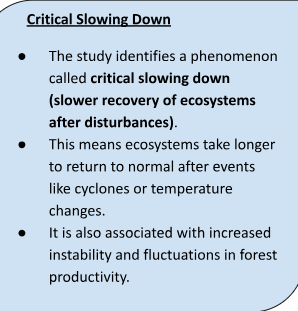
- A recent study shows that around 10–15 percent of the Sundarbans is undergoing a “critical slowing down” process from environmental stress.
Sundarbans
- The Sundarbans is a UNESCO World Heritage Site and is ecologically significant.
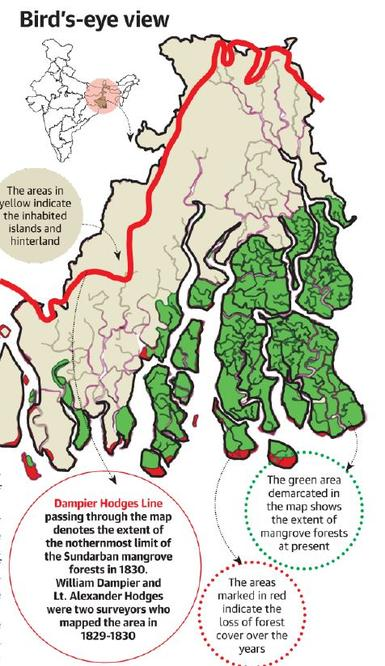
- The world’s largest mangrove forest, spread across the delta formed by the Ganges, Brahmaputra, and Meghna rivers on the Bay of Bengal.
- Shared between India (40%) and Bangladesh (60%).
- Key rivers flowing through this area include Muriganga, Raimangal, Harinbhanga, Saptamukhi, Thakuran, and Matla.
Key Findings
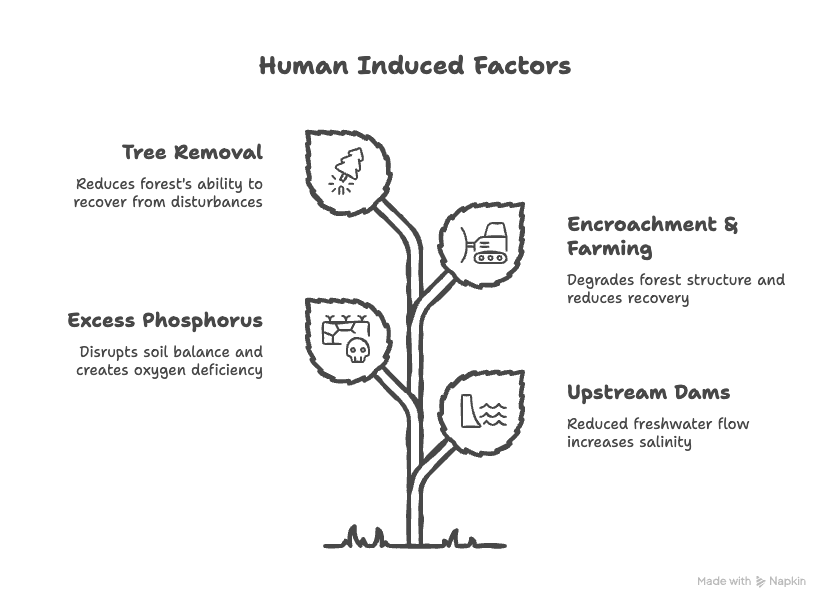
- Climate: Rising temperatures are reducing species richness and weakening ecosystem stability. Freshwater flow and rainfall matter because reduced freshwater increases salinity. Thus, rainfall plays a role in reducing salinity and improving growth conditions. However, erratic rainfall and extreme weather events are disrupting this balance.
- Ecology: The forest includes both fast-growing species like Avicennia officinalis and Excoecaria agallocha. It also includes slow-growing species such as Heritiera fomes, Bruguiera sexangular, and Xylocarpus mekongensis.
- Decline in canopy height and leaf traits is reducing structural complexity.
- Forests are becoming more uniform with fewer species, reducing biodiversity.
- Some parts of the forest are shifting from a carbon sink (absorbing carbon dioxide) to a carbon source.
- Cyclones as Factor: Major cyclones such as Sidr, Rashmi, and Aila of the Bay of Bengal have significantly reduced forest resilience.
- Large areas shifted from high resilience (strong recovery capacity) to moderate and weak categories.
- Affected Zones: The most affected regions are in the central and south-eastern Sundarbans (seaward and cyclone-prone areas).
- In India, the western Sundarbans show lower resilience compared to Bangladesh, especially near northern boundaries.
Way Ahead
- The Sundarbans is vital for biodiversity, coastal protection, and carbon storage (absorption of atmospheric carbon dioxide).
- Declining resilience threatens ecosystem stability, livelihoods, and climate regulation functions.
- Protecting mature trees is essential to maintain resilience.
- Strengthening patrolling can reduce illegal logging and forest degradation.
- Involving local communities can improve awareness and conservation efforts.
- Policies should integrate climate impacts (effects of climate change on ecosystems) for long-term protection.
Source: TH
Next article
News In Short 08-04-2026
